
Angle molding is the fastest, cleanest way to protect and finish an exposed edge. It's an L-shaped profile that wraps an outside corner, caps a raw panel edge, or hides the seam where two surfaces meet.
Every project has edges. Drywall corners get bumped by carts. Laminate and plywood edges chip. Tile and wall panels leave a cut line that needs to look intentional. A length of angle molding solves all of these in minutes, and it costs a fraction of a callback or a repair.
This guide covers where angle molding (also called angle moulding or corner guard) works best, how to choose between plastic and aluminum, how to read the sizes, and how to install it for a clean result.
Where angle molding earns its keep
Outside wall corners. Shields drywall in hallways, schools, hospitals, and retail spaces where carts, chairs, and foot traffic take a toll.
Cabinet and casework edges. Caps exposed plywood, MDF, or laminate edges on cabinets, shelving, and store fixtures.
Panel and tile transitions. Finishes the cut edge where wall panels, FRP, backsplash, or tile stop, so the end looks planned.
Countertops and work surfaces. Protects front edges and corners that see daily impact.
Displays and signage. Frames panels and adds a crisp, finished line to exhibits and point-of-purchase fixtures.
DIY and repair. Covers a damaged corner or an imperfect cut without tearing anything out.
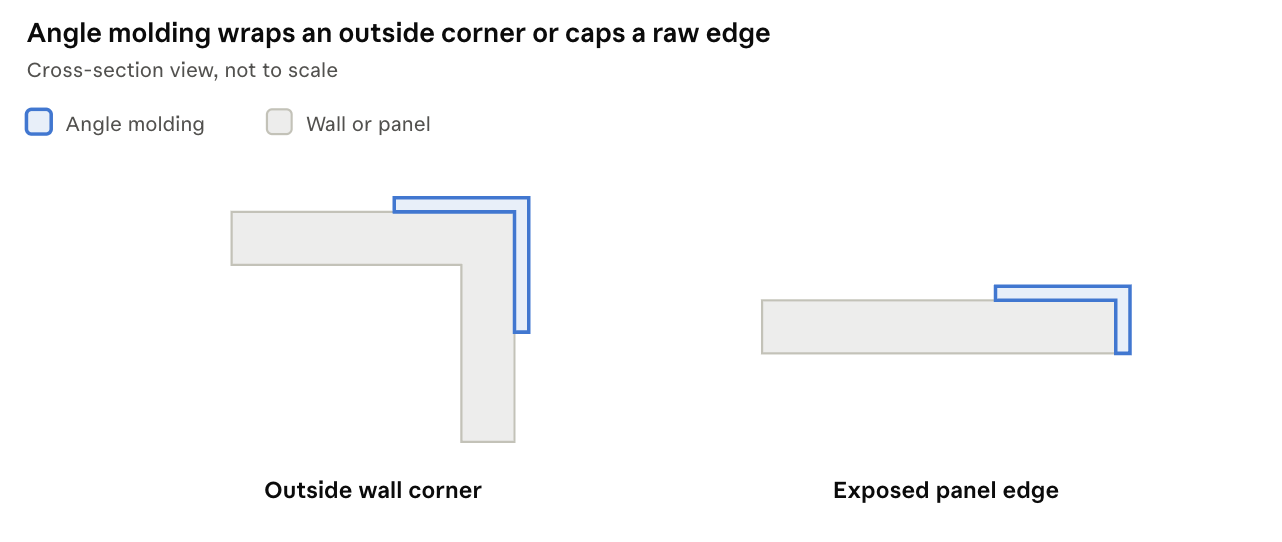
On a corner, both legs cover the two wall faces. On a panel, one leg caps the cut end and the other laps onto the face.
Plastic or aluminum?
Both materials do the same basic job. The right choice depends on the look you want and how much abuse the edge will take.
| Plastic angle molding | Aluminum angle molding | |
|---|---|---|
| Best for | Interiors, moisture-prone areas, color matching | High-impact edges, commercial spaces, a metal finish |
| Look | Many colors, plus clear to disappear against any surface | Clean metallic finish with a modern, architectural feel |
| Strengths | Won't rust or corrode, flexes slightly on impact, easy to cut | Rigid, strong, holds a sharp straight line |
| Cutting | Fine-tooth saw or utility knife on thinner profiles | Miter saw with a non-ferrous blade, or a hacksaw |
Choose clear plastic when you want protection without changing the look of a wall, panel, or wallcovering. Choose aluminum when the edge takes real punishment or when the metal line is part of the design.
How to read angle molding sizes
Outwater lists every angle with three dimensions, so you can match a profile to your project at a glance.
A = vertical leg. The height of the upright side of the L.
B = horizontal leg. The width of the flat side of the L.
C = wall thickness. How thick the material is. Thicker walls are stiffer and stand up to more impact.
Even-leg angles have A and B the same, which suits most outside corners. Uneven-leg angles have one longer leg. Use them when one face needs more coverage, like capping a panel edge while lapping onto the face, or when one side must stay tight to a door or trim.
To size it, measure the surfaces the molding must cover and pick legs that span them with a little overlap. For an edge cap, match the inside dimension to your panel thickness.
Installation tips for a clean finish
Measure and cut. Measure the run, then cut with the right blade for the material. Miter the ends at 45° where two pieces meet at a corner.
Prep the surface. Clean off dust, grease, and loose paint. Adhesive only holds as well as the surface under it.
Dry-fit first. Hold each piece in place to check the fit and the miters before you commit.
Attach it. You can glue it, screw it, nail it, or combine them. Construction adhesive or double-sided mounting tape gives a clean, fastener-free look. Screws or nails add holding power, alone or with adhesive. Pre-drill aluminum and thicker plastic, and use flat-head or countersunk screws so the heads sit flush. Brads or finish nails work well for thinner plastic over wood. On high-impact commercial corners, use mechanical fasteners for the strongest hold.
Press and hold. Apply firm, even pressure along the full length. Tape it in place while the adhesive cures if needed.
Finish the details. Wipe off squeeze-out right away. Use a bead of matching caulk where the edge meets an uneven wall.
Find the right angle at Outwater
Outwater has supplied architects, cabinetmakers, fabricators, and contractors since 1972. Our angle molding line covers plastic and aluminum, even-leg and uneven-leg profiles, and a wide range of colors including clear, all ready to ship.
Not sure which size or finish fits? Order a sample to see and feel it before you buy, or call our team for help matching a profile to your project.